
Dean Faculty of Management & Business Administration

Prof. Dr. Salman Bashir Memon
Dean Faculty of Management & Business Administration
Email: dean.fmba@sbbusba.edu.pk
DEPARTMENT OF ECONOMICS
Introduction
The Department of Economics at Shaheed Benazir Bhutto University proudly offers a comprehensive range of academic programs designed to nurture intellectual excellence, analytical rigor, and professional competence in the field of economics. Our academic portfolio includes: 1. Bachelor of Science (BS) in Economics – 4 Years 2. Bridge Program in Economics – 2 Years 3. M.Phil. in Economics – 2 Years 4. PhD in Economics – 3 Years (to be offered very soon, Insha Allah) Established in 2018, the Department of Economics has steadily evolved into a vibrant academic unit committed to high standards of teaching, research, and community engagement. The flagship BS Economics program is carefully structured to provide students with a rigorous and quantitatively grounded foundation in economic theory and applied methods. Through courses in microeconomics, macroeconomics, econometrics, development economics, and public policy, students develop strong analytical abilities, critical thinking skills, and a sound understanding of real-world economic challenges. Special emphasis is placed on examining the economic dynamics of Pakistan—its development trajectory, policy environment, and socioeconomic transformations—so that our graduates are equipped to contribute meaningfully to national progress.
The Department upholds the principles of liberal arts education by integrating economic reasoning with interdisciplinary perspectives, ethical awareness, and effective communication skills. We are committed to cultivating leadership qualities, intellectual curiosity, and a spirit of inquiry among our students. By combining theoretical knowledge with practical exposure through seminars, research projects, and policy discussions, the Department prepares graduates for diverse and rewarding careers in academia, economic research, financial institutions, banking, public administration, development organizations, and the private sector.
Looking ahead, the forthcoming PhD program will further strengthen our research capacity and academic excellence, providing a platform for advanced scholarship and innovation in economic thought and policy analysis. Through dedication to quality education, research-driven teaching, and service to society, the Department of Economics strives to produce professionals who are not only technically competent but also socially responsible and committed to sustainable and inclusive economic development.
Vision
We are dedicated to creating, disseminating, and applying economic knowledge that contributes meaningfully to Pakistan’s sustainable development, socioeconomic progress, and global academic discourse. Through innovation, integrity, and intellectual leadership, the Department seeks to cultivate economists who are capable of addressing contemporary economic challenges with analytical depth and ethical responsibility.
Mission
Our mission is to foster intellectual curiosity, professional excellence, and civic responsibility, empowering students to actively engage with economic policy matters at local, national, and global levels. We aim to nurture graduates who combine academic competence with moral responsibility, leadership qualities, and a commitment to inclusive and sustainable development.
Objective
1) Academic Excellence in Teaching and Research To maintain and continuously enhance high-quality teaching in Economic Theory, Econometrics, and Quantitative Methods, ensuring that students develop strong analytical and research capabilities. The Department emphasizes rigorous coursework, applied research, and policy-relevant inquiry to prepare students for advanced academic study and professional success.
2) Strengthening Education–Employment Linkages To establish meaningful connections between academic training and employment opportunities by building networks with prospective employers in government agencies, financial institutions, research organizations, development partners, NGOs, and international institutions. Through internships, seminars, career counseling, and industry collaboration, we aim to enhance graduates’ employability and professional readiness.
3) Promoting Research and Knowledge Dissemination To enhance the visibility and impact of research produced by faculty and students through conferences, policy briefs, publications, workshops, and digital platforms. The Department is committed to fostering a vibrant research culture that contributes to evidence-based policymaking and addresses pressing economic challenges facing Pakistan and the wider global community.
For further contact
Dr. Zahid Hussain Channa
Chairman Department of Economics
Email:chairman_economics@sbbusba.edu.pk
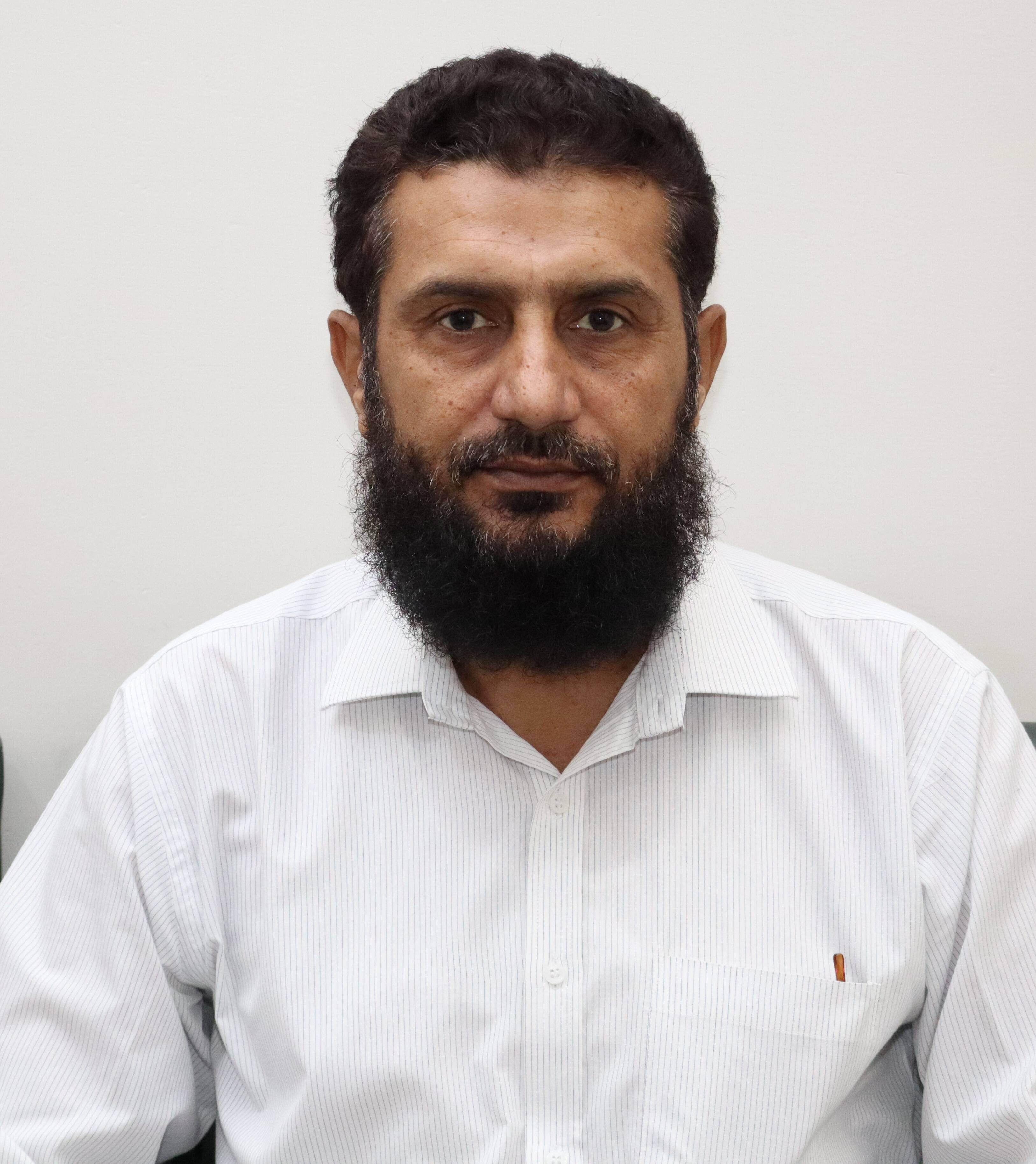
Dr. Zahid Hussain Channa
Chairman Department of Economics
PhD (Development Studies), Pakistan
Email:chairman_economics@sbbusba.edu.pk

Dr. Ahmed Raza Mughal
Assistant Professor
PhD (Economics), Pakistan
Email:ahmedrazamustafa@sbbusba.edu.pk

Mr. Ameet kumar
Lecturer
M.Phil in (Economics and Finance), Pakistan
Email:ameetkumar@sbbusba.edu.pk
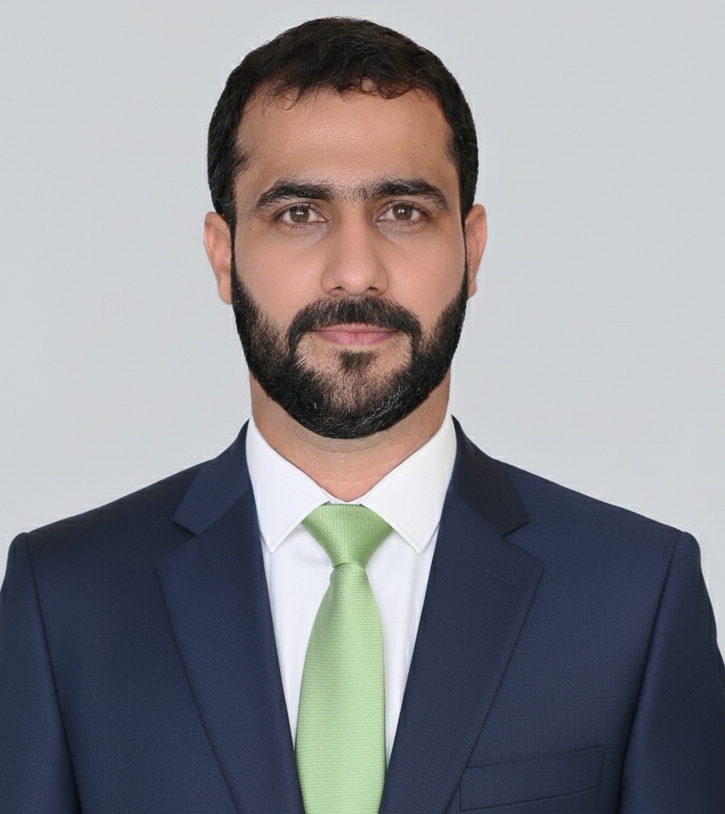
Dr. Waheed Ali
Lecturer
PhD (Economics), China
Email:waheed.ali@sbbusba.edu.pk
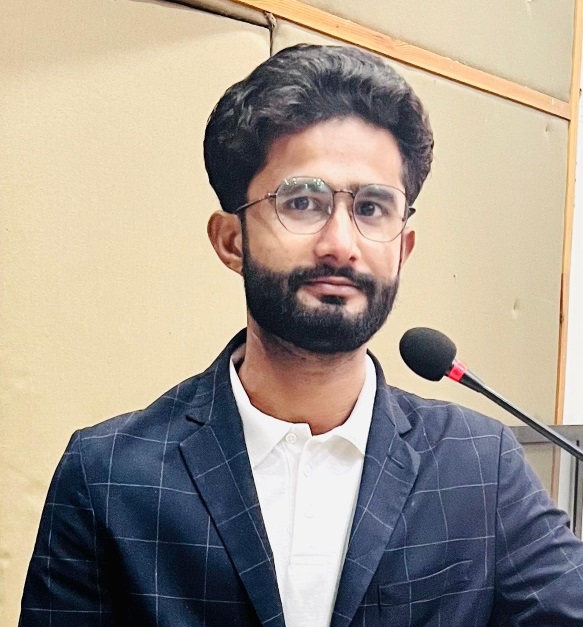
Mr. Ghullam Qadir Shaikh
Teaching Assistant
M.Phil Scholar
Email: gh.qadirshaikh@sbbusba.edu.pk
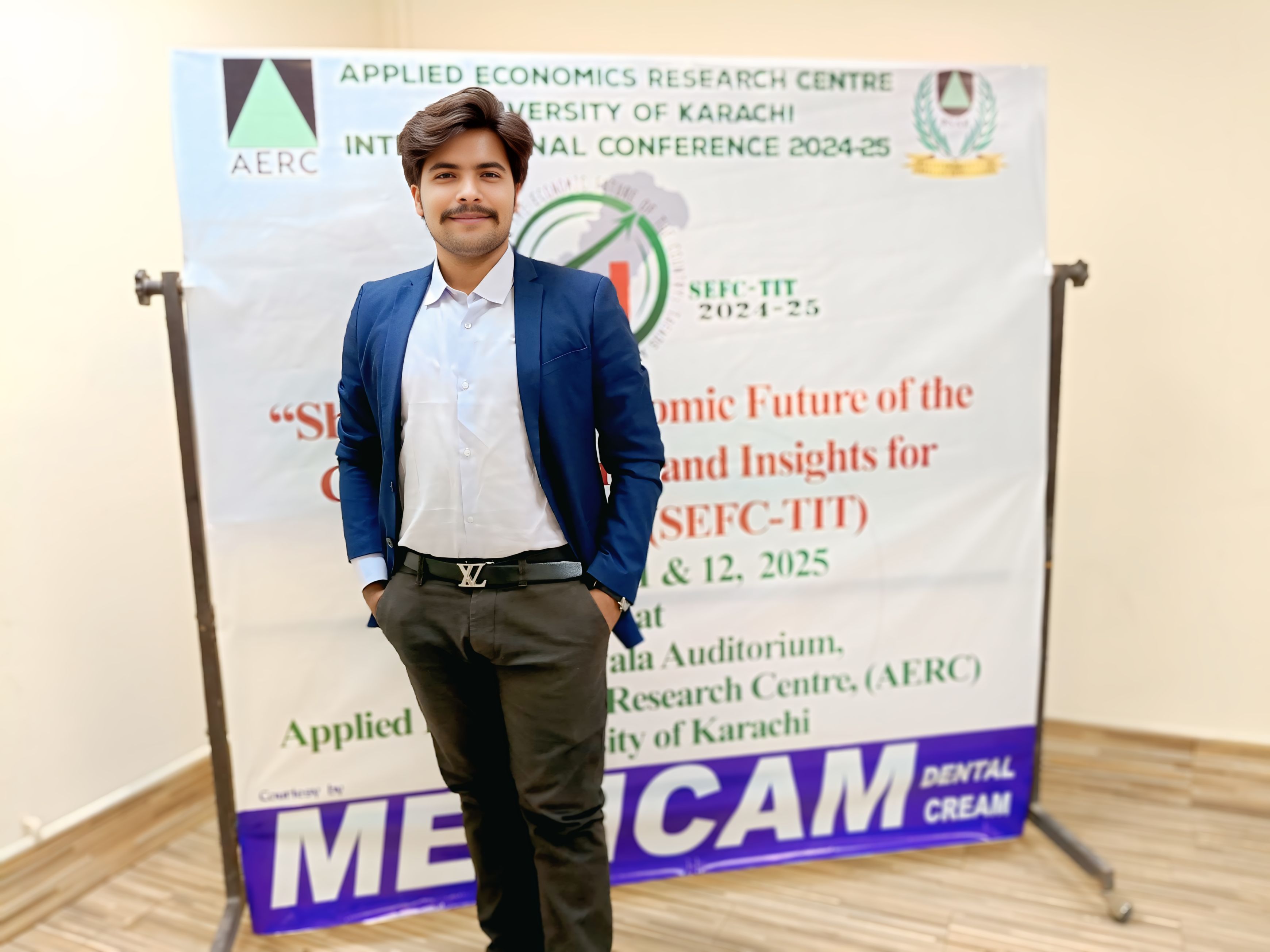
Mr. Shuja Muhammad Juno
Teaching Assistant
M.Phil Scholar
Email: shujamuhammad@sbbusba.edu.pk
| SNo. | Subject | Credit Hours | Marks |
|---|---|---|---|
| 1 | Functional English | 3 | |
| 2 | Principles of Microeconomics | 3 | |
| 3 | Islamic Studies / Ethics | 2 | |
| 4 | Quantitative Reasoning-1 (Basic Mathematics) | 3 | |
| 5 | Introduction to Psychology | 3 | |
| 6 | Political Science | 3 | |
| Total | 17 | ||
| SNo. | Subject | Credit Hours | Marks |
|---|---|---|---|
| 1 | Expository Writing I | 3 | |
| 2 | Constitution of Pakistan | 2 | |
| 3 | Principles of Macroeconomics | 3 | |
| 4 | Statistics – I | 3 | |
| 5 | Introduction to Sociology | 3 | |
| 6 | Modern Economic History of Sindh | 3 | |
| 7 | Civics and Community Engagement | 2 | |
| Total | 19 | ||
| SNo. | Subject | Credit Hours | Marks |
|---|---|---|---|
| 1 | Expository Writing II | 3 | |
| 2 | Intermediate Microeconomics | 3 | |
| 3 | Applications of Information and Communication Technologies (ICT) | 3 | |
| 4 | Quantitative Reasoning II (Intermediate Mathematics) | 3 | |
| 5 | Financial Accounting-I | 3 | |
| 6 | Principle of Marketing | 3 | |
| Total | 18 | ||
| SNo. | Subject | Credit Hours | Marks |
|---|---|---|---|
| 1 | Entrepreneurship | 2 | |
| 2 | Intermediate Macroeconomics | 3 | |
| 3 | Statistics - II | 3 | |
| 4 | Issues in World Economy | 3 | |
| 5 | Financial Accounting-II | 3 | |
| 6 | Introduction to Data Sciences | 3 | |
| 7 | General Science | 3 | |
| Total | 20 | ||
| SNo. | Subject | Credit Hours | Marks |
|---|---|---|---|
| 1 | Microeconomic Analysis | 3 | |
| 2 | Monetary Economics | 3 | |
| 3 | Public Finance | 3 | |
| 4 | Mathematical Economics | 3 | |
| 5 | Basic Econometrics | 3 | |
| 6 | Principles of Microeconomics -Major (For AD) | 3 | |
| 7 | Principles of Macroeconomics-Major (For AD) | 3 | |
| Total | 21 | ||
| SNo. | Subject | Credit Hours | Marks |
|---|---|---|---|
| 1 | International Economics | 3 | |
| 2 | Development Economics | 3 | |
| 3 | Financial Economics | 3 | |
| 4 | Research Methodology | 3 | |
| 5 | Macroeconomics Analysis | 3 | |
| 6 | Intermediate Microeconomics (For AD) | 3 | |
| 7 | Intermediate Macroeconomics (For AD) | 3 | |
| Total | 21 | ||
| SNo. | Subject | Credit Hours | Marks |
|---|---|---|---|
| 1 | Time Series and Panel Data Econometrics | 3 | |
| 2 | Dynamic Optimization | 3 | |
| 3 | Islamic Economics (Diversification) | 3 | |
| 4 | Field Work/Internship | 3 | |
| 5 | Economics of Happiness and wellbeing | 3 | |
| 6 | Urban Economics (Diversification) | 3 | |
| Total | 18 | ||
| SNo. | Subject | Credit Hours | Marks |
|---|---|---|---|
| 1 | General Equilibrium & Welfare Economics | 3 | |
| 2 | Economic Growth | 3 | |
| 3 | Issues in Pakistan Economy | 3 | |
| 4 | Environmental Economics (Diversification) | 3 | |
| 5 | Trade and Development (Diversification) | 3 | |
| 6 | Language | 2 | |
| 7 | Capstone Project | 3 | |
| Total | 20 | ||
Duration: 2 Years (minimum)
Credit Hours: 30
Course Work: 24
Research Thesis: 06
Distribution of Courses:
Compulsory Courses: 12 Credit Hours
Optional Courses: 12 Credit Hours
| SNo. | Subject | Credit Hours | Marks |
|---|---|---|---|
| 1 | Advance Microeconomics | 3 | |
| 2 | Econometric Methods - I | 3 | |
| 3 | Environmental and Natural Resource Economics | 3 | |
| 4 | Computer Applications in Economics | 3 | |
| Total | 12 | ||
| SNo. | Subject | Credit Hours | Marks |
|---|---|---|---|
| 1 | Advance Macroeconomics | 3 | |
| 2 | Econometric Methods - II | 3 | |
| 3 | Research Methodology | 3 | |
| 4 | Computing Research | 3 | |
| Total | 12 | ||
| SNo. | Subject | Credit Hours | Marks |
|---|---|---|---|
| 1 | Research Thesis | 3 | |
| Total | 3 | ||
| SNo. | Subject | Credit Hours | Marks |
|---|---|---|---|
| 1 | Research Thesis | 3 | |
| Total | 3 | ||